Two related traditions, not two sealed categories
Spirituals and gospel songs are both rooted in African American religious experience. They may share biblical imagery, expressive singing and a strong sense of community. That overlap can make a simple sound-based definition misleading: a spiritual can be performed with a choir and piano, while a gospel song can be sung without instruments. Their clearest differences lie in the circumstances in which they developed and the ways people have used them.
Broadly, spirituals took shape among enslaved African Americans, who adapted Christian stories and language within their own musical practices. Gospel music developed later, especially through Black church traditions, as writers and performers created songs for worship and public performance. Neither term describes a single, unchanging style. Listening for a song’s words, structure and performance context is more useful than expecting one unmistakable musical marker.
Spirituals: songs shaped under enslavement
Spirituals emerged in conditions of forced labor, separation and restricted freedom. Many draw on biblical accounts of suffering, deliverance and hope. Stories of exile or liberation could speak powerfully to singers’ immediate lives, even when a lyric did not name those experiences directly. The songs also gave communities ways to express faith and emotion together.
Because spirituals circulated largely through oral tradition, a song might have different words or melodies in different places. Repetition, short phrases and call-and-response patterns can make a spiritual easy to join, but these features are not exclusive to spirituals. Nor does every spiritual have the same mood: some sound mournful, while others are insistent or joyful.
It is worth being careful with claims that particular spirituals were coded escape instructions. A lyric could hold layered meaning, and songs of freedom mattered deeply, but a specific hidden message should not be presented as fact without evidence for that song. After emancipation, spirituals continued to be sung and were also arranged for concert performance. An arrangement can preserve a song while changing how listeners encounter it.
Gospel songs: worship, testimony and new compositions
Gospel songs grew from a later period of African American church music. They include composed songs with identifiable writers as well as music reshaped in performance. Rather than belonging to one historical moment, gospel continued to develop as singers, choirs and congregations found new ways to voice belief, encouragement and personal testimony.
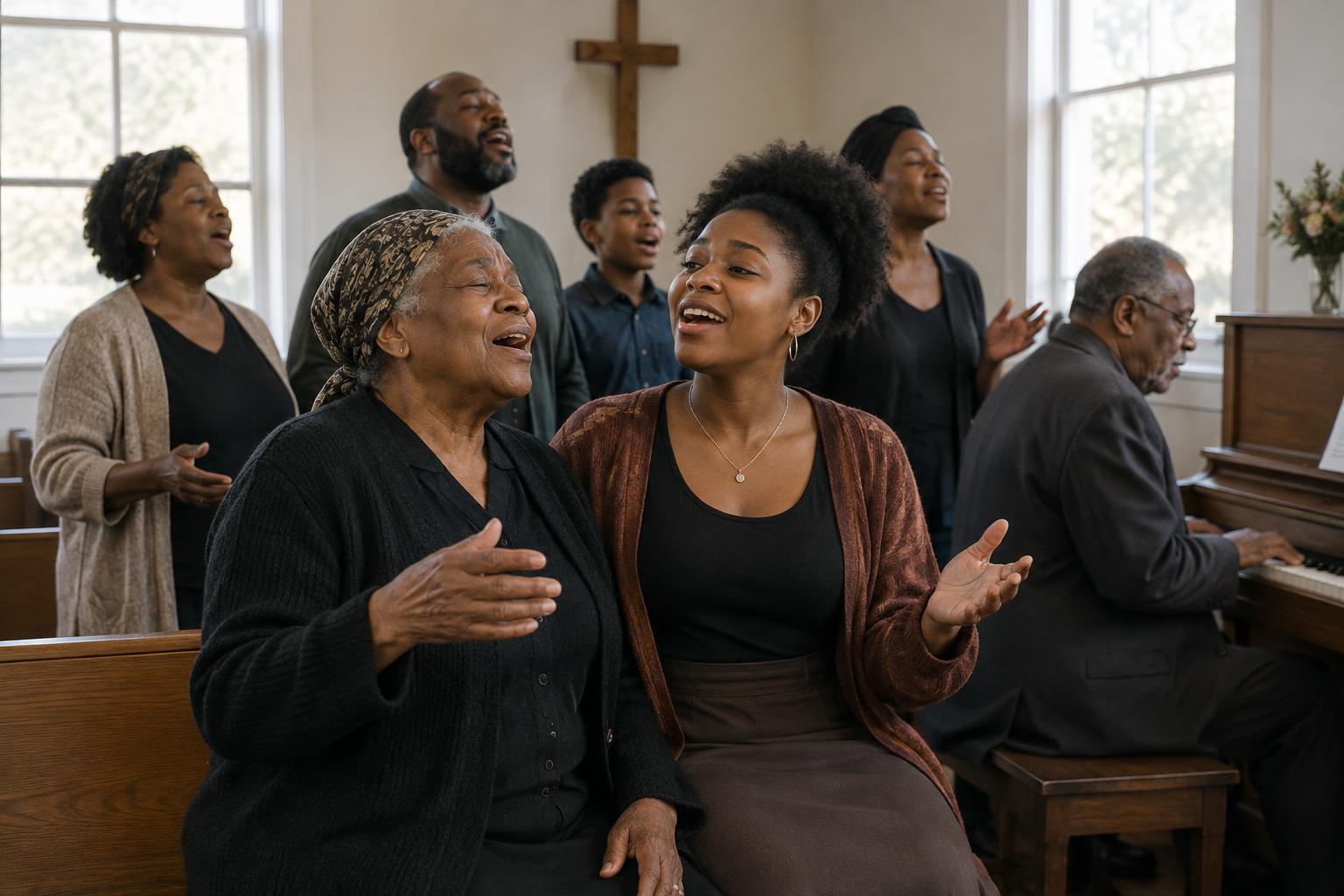
A gospel lyric may address God directly, tell of a change in the singer’s life or invite a congregation to respond. Repeated lines can build intensity and participation. Depending on the setting, a performance might feature a soloist and choir, piano or organ, handclaps, or a fuller instrumental group. These are common possibilities, not requirements: gospel can be quiet and reflective as well as exuberant.
The word “gospel” is also used broadly. It can describe a song, a performance approach or a wider family of church-based styles. For that reason, the presence of a choir or a vigorous rhythm does not, by itself, tell you whether a piece began as a spiritual or was written as a gospel song.
What to listen for
Start with the song rather than the arrangement. Does it belong to a tradition passed on through many versions, or is it usually associated with a particular composer? Are its images drawn from a biblical narrative that leaves room for several interpretations, or does it speak more directly in the voice of personal testimony? These questions can offer clues, though they will not settle every case.
Then listen to how people take part. A leader’s phrase answered by a group can make a song a shared act, whether it is a spiritual or a gospel performance. Notice what repetition does: it may help singers learn a line, allow a congregation to join in or give a soloist room to vary a phrase. Tempo and instrumentation tell you about this performance, but not necessarily the song’s origin.
Why the distinction matters
Calling every older religious song a spiritual can obscure the creative work of later gospel writers and performers. Calling spirituals simply early gospel can flatten the history of enslavement in which they formed. The distinction helps listeners respect both the songs’ origins and the people who have kept them alive.
At the same time, these traditions are connected through generations of singing, adaptation and worship. A spiritual may appear in a contemporary church service; a gospel singer may draw on phrasing familiar from spirituals. If you hear either tradition at a concert or in a place of worship, consider both the song’s history and the purpose it serves for the people performing it now.