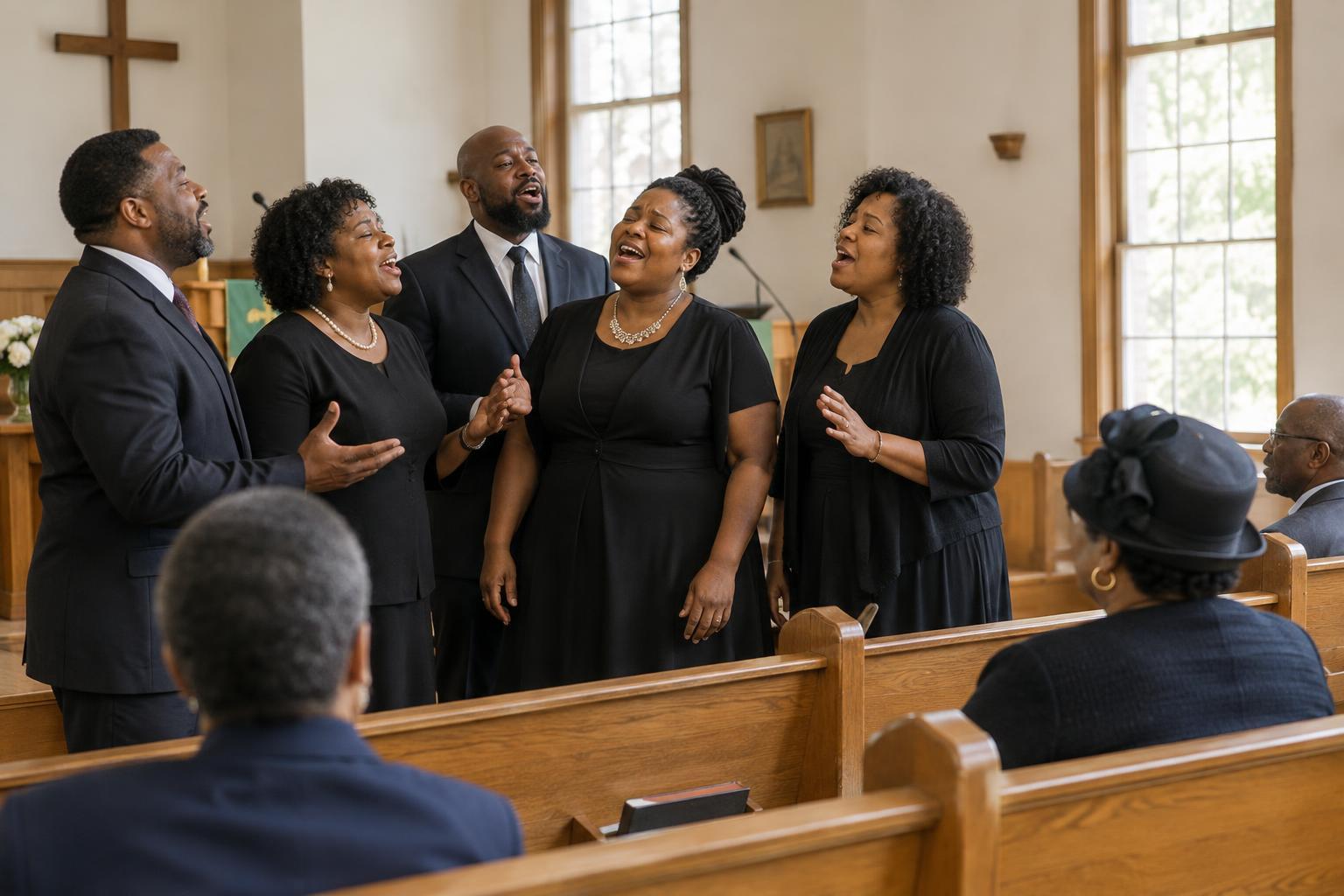
A name for a sound, not always a head count
In gospel music, “quartet” often describes a style of close, interlocking vocal parts rather than a strict count of four people onstage. A group might have additional singers, a featured lead or accompanying players while still working within the quartet tradition. The central exchange is easy to hear: a lead voice carries a line, and the other voices answer, sustain a chord or push the rhythm forward.
That exchange helps explain why quartet singing can feel both intimate and expansive. One singer may deliver a lyric as personal testimony; the group turns it into a shared declaration. Listen for the contrast between a clear melody and the movement beneath it. A held note can make room for the lead, while a quick response can change the energy of an entire phrase.
Rooted in worship and community
Black gospel quartet traditions grew within a wider musical life shaped by churches, community gatherings and the work of singers who learned from one another. Their music drew on sacred song, arranged harmony and the expressive possibilities of call and response. No single sound represents every group: repertoire, vocal approach and accompaniment have varied across places and generations.
A quartet performance can serve several purposes at once. It may invite a congregation to participate, offer encouragement or give voice to grief and hope. Repetition is part of that work. Returning to a line lets singers alter its emphasis, lets listeners recognize it and sometimes opens space for people in the room to answer. Heard only as a recording, the same passage may seem long; heard as part of worship, its length can be part of its meaning.
Quartets also created opportunities for fellowship and musical learning. Singers had to blend, listen closely and make collective decisions about timing. Groups could become a point of pride for a church or community, even as their members balanced music with other responsibilities.
How the style stretches and moves
Early quartet approaches often placed a strong emphasis on carefully balanced parts. Over time, many groups developed more forceful lead singing, sharper rhythmic responses and accompaniment that could include instruments. These are useful listening distinctions, but they are not a tidy sequence in which one style replaced another. Restrained harmony and exuberant delivery have continued to exist alongside each other.
Notice how a performance builds. A song may begin with measured phrasing, then gather intensity as the lead repeats a word, bends a note or leaves an opening for the other singers. The backing voices do more than supply a chord: they can act as a rhythmic engine, a second speaker or a steady center against which the lead takes expressive risks. Different groups make different choices about how far to stretch a phrase before coming back together.
The sounds of gospel quartets have also traveled through recordings and performances beyond their home congregations. Listeners may hear affinities with later popular vocal styles, particularly in the interplay of a distinctive lead and a responsive group. Those connections are worth exploring without treating sacred music merely as a stepping-stone to secular genres. For many singers and audiences, its religious purpose remains central.
Who gets heard, and what a recording cannot show
Accounts of quartet music often focus on prominent male groups, but that focus is not the whole story of Black sacred vocal music. Women have sung, organized, directed and sustained gospel performance in many settings. When exploring a tradition, it helps to ask whose work is visible in recordings and publicity, and whose contributions were more likely to be heard locally or passed on in person.
A recording preserves voices but not every part of an occasion. It may leave out the congregation’s responses, the reason a song was chosen or the relationship between performers and listeners. This does not make recordings less valuable; it suggests a fuller way to hear them. Pay attention to audible audience participation when it is present, and resist assuming that silence means a song was intended for passive listening.
A respectful way to listen
To explore gospel quartets, start with the parts. Follow the lead for one verse, then replay it while attending to the singers behind that voice. Where do they breathe together? When do they echo a word, change the pulse or hold back? On another listen, notice what the lyrics ask the singers and listeners to remember, affirm or anticipate.
Context matters as much as technique. If you encounter quartet singing in a church or community setting, follow the host’s guidance about participation, photography and recording. If you are listening at home, make space for both the craft and the purpose of the music. The harmonies can be admired on their own, but they carry more meaning when heard as part of a living practice of shared expression.