Start by listening for two parts
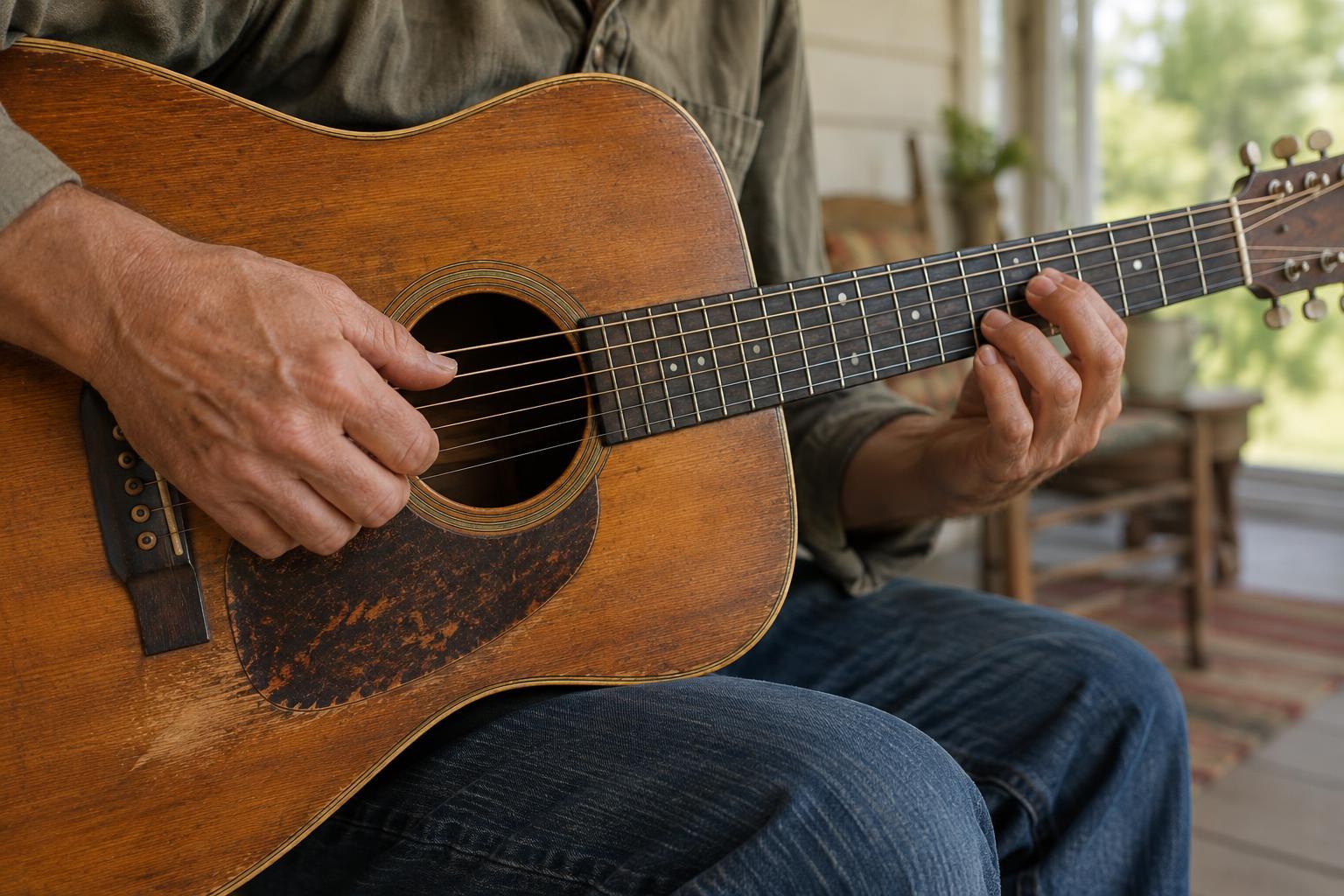
A useful way into Piedmont blues fingerpicking is to imagine that the guitarist is playing a bass part and a melody at the same time. The thumb usually works on the lower strings, setting out a steady pulse. The fingers pick higher strings, adding notes and short phrases around it. You do not need to identify every note to hear the relationship: one part gives you a place to stand, while the other moves around it.
The style is associated with blues playing from the Piedmont region of the eastern United States, but it is not a single, fixed pattern. Players may vary their tuning, tempo, bass movement and choice of melody. Treat the two-part sound as a listening clue, not a rule that every performance must follow.
Follow the thumb before the tune
On a first listen, ignore the brightest notes and concentrate on the low strings. Can you tap along to a repeating sequence of bass notes? The thumb often alternates between two or more strings, creating a regular, walking sensation. Some players also use muted or lightly brushed notes that make the bass feel percussive. Even when you cannot hear each low note clearly, you may sense an even underlying motion.
Try tapping your foot to that motion while the guitar plays. If your foot can keep going through a busy passage, you have probably found the thumb’s pulse. Then notice what happens when the bass changes to support a new chord. It may keep a similar rhythm while moving to different notes. That continuity helps give the music its forward roll.
An alternating bass alone does not prove that a recording is Piedmont blues; related fingerpicking approaches use it too. What matters is how the bass and upper notes work together across a phrase.
Notice where the high notes land
Once you have the bass pulse, shift your attention to the fingers. They may pick a melody note between two bass notes, strike a note just before you expect it, or let a high note ring across the next beat. These placements create syncopation: accents that play against the most obvious pulse without losing it. The effect can feel buoyant, as though the guitar is leaning forward and then settling back.
Listen for brief runs, repeated notes and small answering phrases above the bass. A phrase might sound simple when you hum it, yet intricate when you hear how it fits around the thumb. Some passages have a piano-like or ragtime-influenced bounce; others leave more space. Rather than trying to count everything at once, ask yourself a smaller question: did that high note land with your foot tap, or between taps?
The contrast is easier to catch in a short passage than across a whole song. Replay a few seconds and alternate your attention between low and high strings. You may begin to hear the groove as a conversation rather than a single stream of notes.
Hear the details that keep it human
A repeating picking pattern can make the style seem predictable on paper. In performance, small choices give it character. A player might briefly interrupt the bass, brush several strings instead of picking one, bend or slide into a melody note, or leave a gap for the voice. The pulse can remain clear even when the hands do not repeat a pattern exactly.
Pay attention to how the guitar accompanies singing. The upper strings may answer the end of a vocal line, while the thumb keeps time underneath. Between verses, the guitarist might bring the melody forward for a short instrumental phrase. These changes in emphasis can help you recognize fingerpicking even if the recording is rough or the guitar sits behind the voice.
Sound quality can make individual strings hard to separate. If so, listen for the overall impression: a regular low movement paired with higher notes that dart in and out of it. That relationship is more useful than any one tone or guitar sound.
Use a simple repeat-listen exercise
Choose a short guitar passage and listen to it three times. On the first pass, tap only to the low pulse. On the second, keep tapping and notice each high note that falls between taps. On the third, listen for a change: a bass note moving with the chord, a pause for the singer, or a quick flourish near the end of a phrase. If the parts blur together, slow your tapping rather than trying to catch more notes.
You can also compare two passages without trying to label either one immediately. Does one rely on a steady low-string pattern while its melody skips around the beat? Does the other use broader strums or single-note lines that move mostly in step with the bass? Such comparisons sharpen your ear without reducing a varied tradition to a checklist.
With practice, the first thing you notice may be the feel rather than the technique: a grounded pulse and a playful upper voice sharing one guitar. Follow those two voices, and Piedmont-style fingerpicking becomes easier to hear.