Start with the sound of a dominant seventh chord
A piano voicing is the particular arrangement of notes you choose for a chord. You can play the same chord in several ways: close together or spread across the keyboard, with its root at the bottom or with another note underneath. In blues, those choices help you shape a groove without filling every bit of space.
A useful starting point is C7, a dominant seventh chord made of C, E, G and B-flat. The C names the chord; E is its third; G is its fifth; and B-flat is its flat seventh. Try playing all four notes, then release the G and listen again. The leaner sound still gives you much of C7’s character. That is why small voicings can work so well when you are accompanying a singer, guitarist or your own right-hand melody.
For the examples below, use a blues in C. Its three main chords are C7, F7 and G7. You need not memorize a page of shapes before playing: first get familiar with how each chord sounds, then notice which notes can move only a short distance when the harmony changes.
Build compact voicings from the third and seventh
The third and seventh form a handy two-note shape often called a shell voicing. For C7, play E and B-flat. For F7, play E-flat and A. For G7, play F and B. Play each pair slowly, either together or as a gentle alternating pattern. These notes do not state the root, so they are clearest when a bass player supplies it or when you add the root elsewhere on the piano.
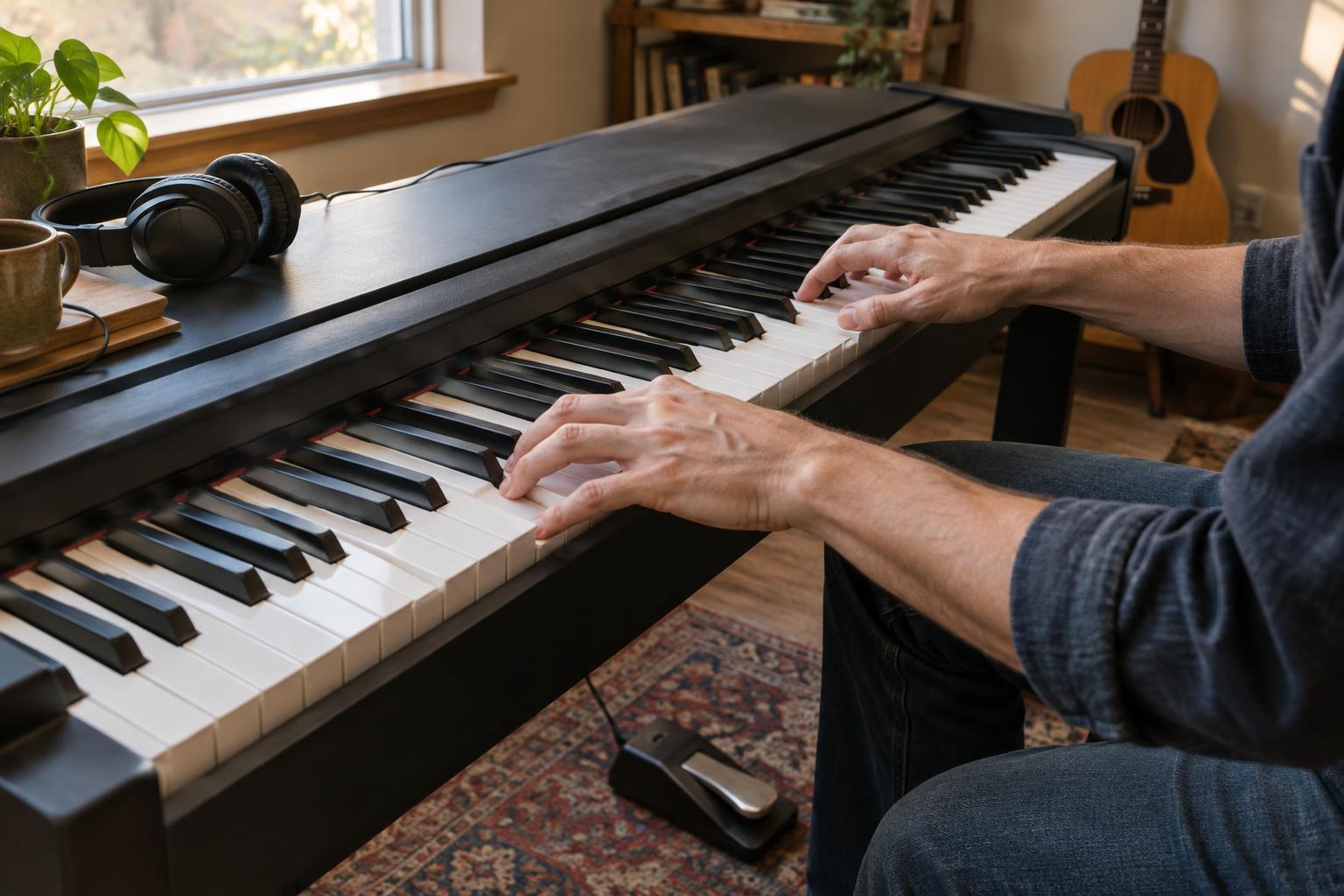
To hear them in context while playing alone, put C, F or G in your left hand and the matching pair in your right. Keep the right-hand notes near the middle of the keyboard rather than jumping to a new position for every chord. Moving from C7 to F7, E can slip down to E-flat while B-flat moves down to A. Small movements like these make the chord change sound connected.
If reaching for a bass note and a shell at once feels awkward, play the root first and the two-note shape immediately afterward. This broken-up version is still accompaniment. Work at a comfortable tempo and aim for an even sound before trying to play faster.
Take the voicings through a 12-bar blues
A common 12-bar pattern in C spends four bars on C7, two on F7, two more on C7, then one each on G7, F7, C7 and G7. That last G7 sets up the return to the beginning; if you are ending the tune instead, you can settle on C7. Other 12-bar variations exist, but this pattern provides a clear place to practise chord changes.
Count four steady beats per bar. At first, play a bass note and shell together on beat one, then let the sound ring while you count the remaining beats. This simple exercise reveals whether you can find the next shape without stopping. Once the changes feel familiar, try a root on beat one and a light right-hand chord on beats two and four. Leave the other beats open rather than feeling obliged to fill them.
Blues can be played with different rhythmic feels. You might hear an even pulse, a shuffle or a swung feel, depending on the performance. Start by keeping reliable time; choose a more specific feel once you can move through the form comfortably.
Add color without crowding the chord
When the basic shells feel secure, add one note at a time to hear what changes. Over C7, try D above E and B-flat. D acts as a ninth, giving the chord a wider, brighter sound. You can also put G back into C7 for a fuller shape. Neither addition is required: the best choice depends on the register, the rhythm and what other musicians are playing.
Blues melodies often use E-flat against a C7 setting, even though the chord itself contains E. That contrast can sound expressive, especially when E-flat is used as a passing note leading toward E. Try playing a short right-hand phrase with E-flat and E while your left hand marks C. Listen to the tension and release rather than holding every note down at once.
If a voicing sounds muddy, move it higher, remove a note or separate the bass note from the chord in time. Low notes close together can be difficult to distinguish. A smaller shape played clearly is often more useful than a larger one played heavily.
Make a short practice routine you can repeat
Begin each session by finding C7, F7 and G7 as full chords so you can hear their overall sound. Next, reduce them to the third-and-seventh pairs and move between the pairs without a steady beat. Then play one full 12-bar chorus with roots and shells, counting aloud if that helps you stay oriented.
On a second chorus, change just one thing: use a broken-up rhythm, add a ninth to one chord or leave a bar especially sparse. Record yourself if you can, then listen for steady time and clear chord changes rather than speed. The aim is not to collect as many voicings as possible. It is to find a few sounds you can place confidently, leaving room for the groove, the melody and the people playing alongside you.